Inquiry
Form loading...

Top Park Playground Equipment Manufacturers Worldwide?

Choosing among the top Park Playground Equipment manufacturers worldwide is not a simple popularity contest. A playground must invite movement, withstand daily use, and remain welcoming to children with different abilities. The stakes are practical. A loose bolt, faded surface, or poorly shaded slide can change how a space feels.

The World Health Organization’s Global Status Report on Physical Activity 2022 notes that 81% of adolescents aged 11–17 do not meet recommended activity levels. Play spaces cannot solve that problem alone. Still, thoughtful design can make active play easier to reach. Buyers should look beyond bright colors and impressive catalog images. Equipment materials, age-appropriate layouts, accessible routes, spare-part availability, and maintenance guidance deserve close review. The U.S. Consumer Product Safety Commission’s Public Playground Safety Handbook offers detailed guidance on playground hazards, surfacing, and equipment layout. It is a useful reference, though it does not replace local requirements or project-specific assessment.

This guide compares manufacturers by product range, design capability, safety documentation, customization, and support after installation. Details matter. Can a supplier provide clear inspection instructions? Are replacement components available years later? Does its equipment suit a coastal park, a compact schoolyard, or a sun-exposed neighborhood site? No ranking can answer every project’s needs. Manufacturer claims also need scrutiny; glossy photographs are not proof of long-term performance. Use this overview as a starting point, then verify specifications, references, and maintenance commitments before making a decision.

Top Park Playground Equipment Manufacturers Worldwide?

What Defines a Leading Park Playground Equipment Manufacturer?

What Defines a Leading Park Playground Equipment Manufacturer?

A leading manufacturer designs for real use, not just attractive renderings. Decks should drain after rain, handrails should feel secure to small hands, and moving parts should resist wear. The CDC reports that more than 200,000 U.S. children aged 14 and younger receive emergency treatment for playground-related injuries each year. That figure makes clear why fall zones, impact-attenuating surfacing, and clear installation instructions matter. A sales claim is not enough. Buyers should ask for test documentation, material specifications, and maintenance guidance aligned with the CPSC Public Playground Safety Handbook and ASTM F1487.

Good design also invites varied movement and access. WHO’s 2020 physical activity guidelines recommend that children and adolescents average at least 60 minutes of moderate-to-vigorous activity daily. Play equipment cannot deliver that alone, but climbing routes, balance elements, and imaginative spaces can encourage children to keep moving. A reliable supplier explains age ranges, accessible routes, and surfacing limits in plain language. The details matter: a transfer platform, for example, needs a usable approach, not merely a label claiming accessibility.

Durability is visible in the small choices. Ask how coatings handle chipped edges, how replacement parts are identified, and whether local crews can inspect wear points. Compare lifecycle costs, not only purchase prices. That takes time. Even strong equipment needs regular checks, and manufacturer guidance should make those checks practical. A weakness worth questioning is whether the design suits the actual site: shade, drainage, supervision, and community needs can differ sharply from the catalogue image.

How Playground Equipment Is Designed for Safety and Accessibility

How Playground Equipment Is Designed for Safety and Accessibility

Safe playgrounds begin with the ground beneath the equipment. The U.S. Consumer Product Safety Commission’s Public Playground Safety Handbook recommends impact-attenuating surfaces and regular checks for wear, gaps, and exposed foundations. The Centers for Disease Control and Prevention has reported that more than 200,000 children aged 14 and younger receive emergency care for playground-related injuries each year. That figure is a reminder: a soft surface helps, but it cannot prevent every fall. Designers also consider fall height, equipment spacing, handholds, and clear sightlines for caregivers.

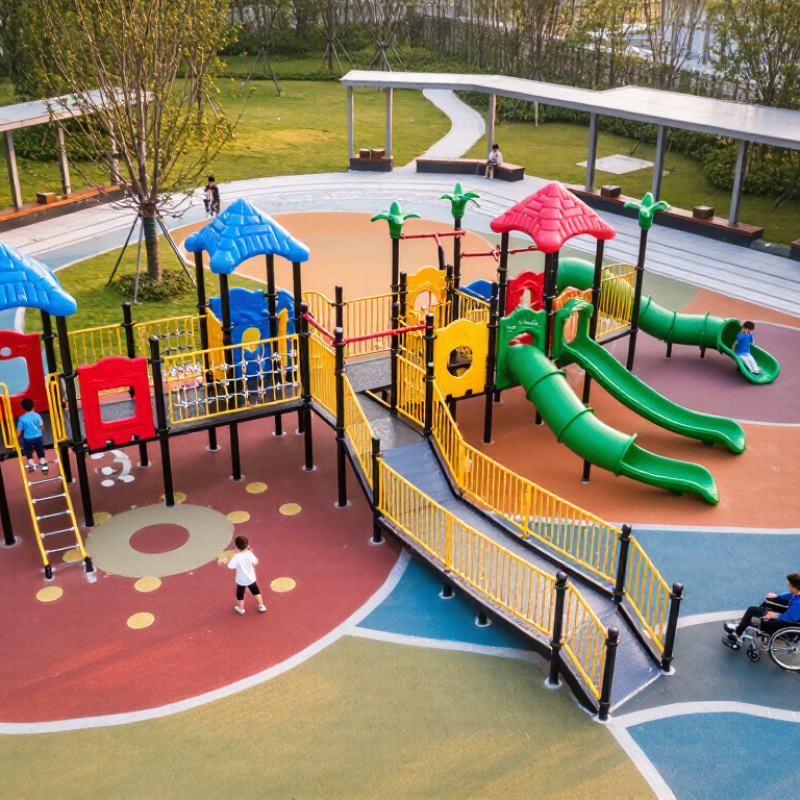
Accessibility takes more than adding a ramp. In the United States, ADA Standards for Accessible Design address accessible routes and play components; other regions apply their own requirements. A thoughtful layout connects the entrance, transfer points, and play zones, with firm paths and enough room to turn. Sensory panels, ground-level activities, and shaded seating can make a visit work for more children and caregivers. A plan may look inclusive on paper. Yet a narrow turn or hot metal seat can make the real experience difficult. That deserves another site review.

Tips: Walk the route with a mobility device before opening. Check surface firmness after rain, and inspect joints and fasteners on a regular schedule. Record repairs; small defects are easy to overlook.

Top Park Playground Equipment Manufacturers Worldwide? - How Playground Equipment Is Designed for Safety and Accessibility

Design Dimension Safety or Accessibility Benchmark How It Informs Playground Design Relevant Guidance
Age-appropriate play Plan play areas around the developmental needs of children ages 2–5 and 5–12. Use age-appropriate equipment, challenge levels, layouts, and supervision sightlines. Separate areas where different abilities or play patterns could create conflicts. U.S. Consumer Product Safety Commission, Public Playground Safety Handbook
Impact-attenuating surfacing Use surfacing tested for impact attenuation, with a critical fall height at least equal to the equipment’s fall height. Specify and maintain surfacing across the entire use zone. Check for displacement, compaction, wear, and exposed foundations during inspections. ASTM F1292; U.S. Consumer Product Safety Commission guidance
Fall height and use zones Assess the maximum fall height and provide the applicable use zone around each structure. Keep use zones clear of obstacles such as benches, fences, trees, and other equipment. The required layout depends on equipment type and applicable standards. ASTM F1487; U.S. Consumer Product Safety Commission guidance
Accessible routes Provide an accessible route connecting the play area with accessible site features and accessible play components. Design route surfaces and transitions to support wheelchair and mobility-device travel. In the U.S., the ADA Standards generally limit accessible-route running slope to 1:12 and cross slope to 1:48. 2010 ADA Standards for Accessible Design
Accessible play components Provide access to a range of play experiences, rather than relying on a single accessible feature. Include ground-level activities and, where applicable, elevated components reached by compliant ramps or transfer systems. Consider different types of movement, sensory engagement, and social play. 2010 ADA Standards for Accessible Design, Section 240
Transfer systems Where transfer systems are used, the ADA Standards specify a transfer-platform height of 11–18 inches (280–455 mm). Provide a clear transfer space and a stable sequence of transfer steps. Place activities within reach and allow caregivers to assist where appropriate. 2010 ADA Standards for Accessible Design, Section 1008
Entrapment and protrusion hazards Design openings, connections, and exposed hardware to reduce risks of entrapment, entanglement, and impact injury. Review openings and moving parts against applicable test probes and safety requirements. Avoid exposed bolts, sharp edges, and clothing-catching projections. ASTM F1487; U.S. Consumer Product Safety Commission guidance
Inspection and maintenance Use routine inspections and keep records of maintenance and repairs. Check surfacing, fasteners, structural stability, moving parts, drainage, and accessible routes. Close equipment that presents an immediate hazard until it is repaired. U.S. Consumer Product Safety Commission, Public Playground Safety Handbook

Standards and accessibility requirements vary by country and may be updated. Confirm the applicable local codes and current editions during design, procurement, installation, and inspection.

Which Manufacturers Supply Park Equipment Across Global Markets?

Park equipment reaches global markets through several supply models. Some manufacturers design and build complete playground systems, then ship them through regional distributors. Others supply components, such as slides, climbing panels, swings, and shade structures, for local assembly. A few work with project teams on custom layouts, adapting equipment to a park’s footprint, age groups, and climate.

The route matters. A distributor may provide faster delivery and local installation support, while direct purchasing can offer more design flexibility. Buyers should check material specifications, assembly instructions, maintenance schedules, and the availability of replacement parts. Ask how the supplier handles freight damage and whether installation guidance is included. Small details count: a missing fastener can delay an opening, and a long wait for a replacement panel can keep equipment out of use. A polished catalog is useful, but it does not show everything. Samples, project references, and clear documentation give a more grounded picture. Even then, comparisons can be messy; shipping costs and site conditions vary widely.

How Manufacturers Differ in Materials, Products, and Standards

Park playground equipment manufacturers differ in more than appearance. Their material choices shape durability, upkeep, and how equipment feels in daily use. Coated steel can suit busy sites, but damaged coatings may need prompt attention. Stainless steel resists corrosion well, though it can raise project costs. Timber offers a softer, natural look; it also needs regular checks for moisture damage and splinters. No material is perfect.

Product ranges vary, too. One manufacturer may focus on toddler play structures, while another offers climbing nets, swings, or accessible play elements. Look closely at joints, handholds, surface finishes, and how children move between activities. Small details matter. A crowded layout can feel less welcoming, even when the equipment itself is sound. That is easy to overlook on a catalogue page.

Standards are another important difference. Requirements vary by location and project, so buyers should confirm which safety standards apply before specifying equipment. Ask for relevant test documentation, installation guidance, surfacing recommendations, and a clear maintenance schedule. Check that the recommended surface is suitable for the equipment’s fall height. Not always. Documentation helps, but it does not replace careful installation and routine inspections. A manufacturer’s support for spare parts and repairs can also affect long-term reliability.

What to Consider When Choosing a Playground Equipment Manufacturer?

When comparing park playground equipment manufacturers, look beyond polished catalog photos. Ask how each structure is designed for your site’s age groups, space, climate, and expected foot traffic. A busy public park may need surfaces and components that withstand daily use, rain, and repeated cleaning. Request details on materials, coatings, hardware, and replacement-part availability. Check whether product documents clearly state age ranges, installation requirements, and relevant safety testing. Good documentation matters. It helps your team verify claims instead of relying on sales language. Ask who performs inspections after installation and what maintenance schedule the manufacturer recommends.

Safety is not a feature you can judge from a picture. Confirm that layouts allow clear sightlines and that fall zones are shown on site plans. A manufacturer should explain how its designs align with applicable local standards, without promising that one product suits every location. Ask how custom requests affect testing, delivery, and future repairs. Walk the site with the proposed layout. Would caregivers see children behind a tower? Also review warranty terms and lead times for commonly replaced parts. A low quote can seem attractive, but delayed repairs may cost more. Some details will remain uncertain until the equipment is installed; acknowledge that, and get responsibilities in writing before committing.