How to Choose the Best Childrens Indoor Slide
Choosing a Childrens Indoor Slide is not just about finding a bright color that fits the playroom. Height, stability, landing space, and the child’s age all matter. A slide that looks compact online may need extra clear floor space at its base. Measure the room, including the area around the slide, before comparing models.
Safety data deserves careful reading. The U.S. Consumer Product Safety Commission’s Public Playground Safety Handbook reports that more than 200,000 children receive emergency-room treatment each year for playground-equipment-related injuries. That figure concerns playground equipment broadly, not indoor slides alone, so it should not be treated as a slide-specific risk estimate. Still, it is a useful reminder to check the product’s age and weight limits, assembly instructions, handholds, and surface beneath the landing area. Small details count.
Play has developmental value, too. In the American Academy of Pediatrics report “The Power of Play,” pediatrician Dr. Michael Yogman and coauthors write, “Play is not frivolous: it enhances brain structure and function.” A slide can encourage movement and repeated practice, but it cannot replace attentive supervision or a suitable play space. This guide will help you compare materials, dimensions, safety features, and ease of cleaning. No single model suits every home. That is worth remembering.
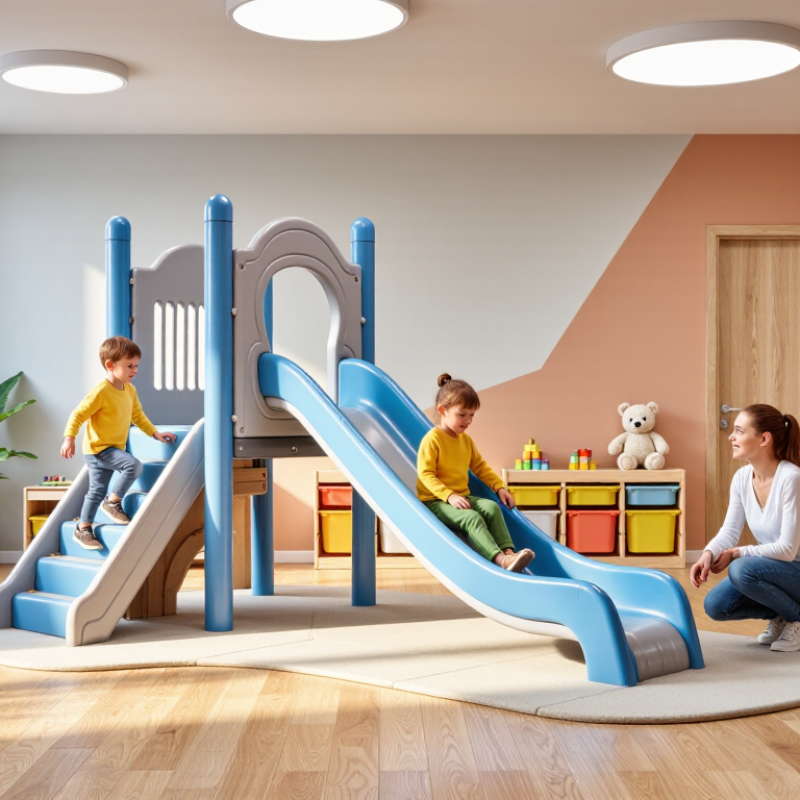
Define the Child’s Age Range Using ASTM F963 Small-Parts Test Criteria
When choosing an indoor slide, start with the child’s age, not the slide’s color or height.
ASTM F963 uses a small-parts test to help identify components that could pose a choking hazard to children under three. A part that fits inside the standard test cylinder may be considered a small part.
Small parts matter.
Check the age label and product information for warnings about detachable pieces. Knobs, caps, and decorative attachments deserve a close look, especially if they can come loose during ordinary play. For a child under three, avoid slides with accessible small parts. For older children, still consider whether younger siblings share the play area. An age label is useful, but it cannot account for every home.
The test addresses choking risks, not every aspect of slide safety. It does not tell you whether a slide is stable, whether its steps suit your child, or whether there is enough clear space around it. I would check those details separately: press gently on the assembled slide, inspect fasteners, and leave a soft, unobstructed landing area.
A tiny part can be easy to miss.
That is why checking the packaging and assembly instructions matters, even when the slide itself looks sturdy.
Measure Room Clearance Before Comparing Slide Height, Length and Width
Before comparing slide height, length, and width, measure the exact area where it will stand. Use a tape measure, and note nearby walls, furniture, door swings, and low light fixtures. A room can look roomy and still feel cramped. Leave open space around the slide and at its exit, following the clearance guidance in the product instructions. Children need room to climb and step away without bumping into a table or wall.
Check ceiling height above the climbing area, not just the slide’s highest point. Then compare the listed dimensions with your measurements, remembering that handles or a curved base may extend beyond the main frame. A slide that fits on paper may block a walkway in daily use. Mark its footprint on the floor with painter’s tape, including the landing area, and walk around it. This simple check can reveal awkward corners before assembly. If the room is shared, measure with doors open and furniture in its usual position; moving a chair later is possible, but it may not stay moved.
How to Choose the Best Childrens Indoor Slide - Measure Room Clearance Before Comparing Slide Height, Length and Width
| Example slide size |
Slide dimensions
(H × L × W) |
Slide footprint
(L × W) |
Planning area with 24 in clearance on each side |
Example room check |
What to consider |
| Compact toddler slide |
36 × 48 × 20 in
(91 × 122 × 51 cm) |
48 × 20 in
(122 × 51 cm) |
96 × 68 in
(244 × 173 cm) |
Room area: 120 × 84 in; ceiling: 96 in
Fits the example planning area |
Suitable for a smaller play space, provided the exit area stays clear and the slide is used on a stable, level surface. |
| Mid-size indoor slide |
42 × 60 × 22 in
(107 × 152 × 56 cm) |
60 × 22 in
(152 × 56 cm) |
108 × 70 in
(274 × 178 cm) |
Room area: 120 × 84 in; ceiling: 96 in
Fits the example planning area |
Check that the full slide length and landing area fit without blocking doors, walkways, or furniture. |
| Tall slide |
48 × 72 × 24 in
(122 × 183 × 61 cm) |
72 × 24 in
(183 × 61 cm) |
120 × 72 in
(305 × 183 cm) |
Room area: 120 × 84 in; ceiling: 96 in
Fits by area; check exact placement |
Measure the ceiling above the highest point and check the product instructions for required overhead and landing clearance. |
| Long, wide slide |
48 × 72 × 30 in
(122 × 183 × 76 cm) |
72 × 30 in
(183 × 76 cm) |
120 × 78 in
(305 × 198 cm) |
Room area: 120 × 84 in; ceiling: 96 in
Length fits exactly; width fits |
Allow for measuring error and nearby obstacles; a tight fit can leave too little usable clearance around the equipment. |
| Large playroom slide |
54 × 84 × 30 in
(137 × 213 × 76 cm) |
84 × 30 in
(213 × 76 cm) |
132 × 78 in
(335 × 198 cm) |
Room area: 120 × 84 in; ceiling: 96 in
Does not fit the example planning area |
Consider a smaller slide or a larger room. Confirm the assembled dimensions, not just the storage or package size. |
How to use this comparison: Measure the clear floor area and ceiling height at the intended location, accounting for skirting boards, furniture, doors, and walkways. The 24 in (61 cm) clearance shown on each side is a planning allowance for comparison, not a universal safety standard. Required spacing varies by product and setup; follow the slide manufacturer’s instructions and check the specified age, weight, and supervision requirements. Dimensions above are representative examples for planning, not specifications for a particular product.
Check EN 71-8 Compliance for Slides and Domestic Activity Toys
When choosing a children’s indoor slide, check whether it is tested to EN 71-8, the European toy-safety standard for domestic activity toys. It covers activity toys such as slides and sets out safety requirements and test methods. Ask for a test report or declaration that identifies the exact model and applicable standard; a generic “tested” claim is hard to verify. Small details matter.
The U.S. Consumer Product Safety Commission’s 2023 Toy-Related Deaths and Injuries report estimated 231,700 toy-related injuries treated in emergency departments that year. This figure covers toys broadly, not indoor slides alone, but it shows why careful product checks matter. Look for clear age and assembly instructions, stable supports, secure joints, and a slide path free of sharp edges. Check the specified user limits, too. A safety standard is not a substitute for correct assembly or adult supervision.
At home, measure the floor space before buying. The slide should sit level, with clear room at its base and no hard furniture in the landing area. Recheck screws and plastic joints regularly, especially after moving it. Standards help, but a report cannot tell you whether the slide fits your room. That part is easy to miss.
How to Choose the Best Children’s Indoor Slide
Use this EN 71-8 review checklist when comparing domestic activity slides. It highlights topics to verify; it is not a test result or proof of compliance.
Check the slide’s stability and structural strength, look for entrapment hazards and fall-related risks, and read the warnings and instructions. Confirm the applicable EN 71-8 edition and supporting conformity information for your market.
Assess Stability, Guardrails and Fall Zones Against ASTM F1148
How to Choose the Best Childrens Indoor Slide
Stability, guardrails, and fall space deserve more attention than bright colors. ASTM F1148 covers safety and performance for residential playground equipment, including relevant structural and entrapment hazards. Check the current standard and the slide’s instructions; a standards reference alone does not confirm that every installation is safe. Press down on the steps and platform. Watch for rocking, loose joints, or a base that shifts on smooth flooring. Guardrails should help prevent a child from stepping or sliding off, without openings that could trap a head or limb.
Fall zones matter indoors, too. Keep the landing area clear of furniture, hard toys, and walls, and use only the protective surface specified by the manufacturer. The U.S. Consumer Product Safety Commission’s 2023 playground-equipment injury report estimated 145,500 emergency-department-treated injuries among children under 16. That figure covers playground equipment broadly, not indoor slides alone, but it shows why a clear landing area is worth checking.
Tips: Set the slide on a level floor, test it with gentle pressure, and inspect fasteners regularly. Measure the landing space rather than guessing. A stable slide can still be poorly placed. I would not rely on a standards label instead of checking the actual setup; household floors and room layouts vary, and the instructions can be easy to overlook.


 CONTACT NUMBER

 CONTACT NUMBER
 CONTACT NUMBER